
॥ जय श्री राम ॥
Rice, the soul of Asia and the staple of more than half the world’s population, has not had an easy journey. Among the many threats that haunt rice cultivation, one stands tall as a relentless, intelligent, and evolution-hardened foe: Rice Blast Disease, caused by the fungus Magnaporthe oryzae.
This is not just a story about a plant disease. It’s about history, weather, biology, culture, and even ritual. It connects old village myths with cutting-edge CRISPR labs, rural farmer wisdom with global food security debates.
Let us walk through this rich, real-life saga — every stage explained clearly, with the genuine learner in mind.
1. What Is Rice Blast?
Rice Blast is a fungal disease that affects rice plants (Oryza sativa) and can appear at any growth stage — seedling, tillering, panicle initiation, flowering, or grain filling.
Names and Aliases:
- Scientific: Rice Blast, caused by Magnaporthe oryzae (formerly Pyricularia oryzae)
- Field Names: Leaf blast, Neck blast, Node blast, Collar blast
- Cultural: “Mochi-byo” in Japan (rice cake disease), “Black neck” in Eastern India
It is notorious for reducing yields drastically, especially when it attacks the neck and panicle. The disease is globally present in over 85 rice-growing countries, making it one of the most serious challenges in rice agriculture.
2. The Causal Organism: Magnaporthe oryzae
This is a filamentous fungus in the Ascomycota phylum. It infects rice by producing airborne spores that land on leaves, germinate in moisture, and penetrate the plant surface.
Scientific Classification:
- Kingdom: Fungi
- Phylum: Ascomycota
- Class: Sordariomycetes
- Order: Magnaporthales
- Family: Magnaporthaceae
- Genus: Magnaporthe
- Species: M. oryzae
Perfect vs Imperfect Stages:
- Perfect stage (sexual): Magnaporthe oryzae
- Imperfect stage (asexual): Pyricularia oryzae — most commonly seen in fields
This organism is highly adaptable and evolves rapidly, often overcoming resistance genes in rice within a few years.
3. History of Rice Blast
A. First Scientific Record:
- Year: 1704
- Place: Japan
The first detailed outbreak was recorded during the Edo period, with widespread losses and fear.
B. Ancient Hints:
- Vedic and Ayurvedic agriculture texts mention symptoms like leaf drying, black grain tips, and neck shriveling — possibly early observations of blast.
- China: Ancient term “火病” (fire disease) matches blast symptomatically but not confirmed.
C. Discovery of Causal Organism:
- 1891: Cavara (Italy) described Pyricularia oryzae from rice leaves
- Koch’s postulates were fulfilled by infecting healthy plants in lab settings
D. Major Outbreaks:
- India, 1965: Severe outbreak in Andhra Pradesh, TN1 variety affected
- Japan (1910–1950): Frequent epidemics
- Philippines (1980s–90s): IRRI reformulated breeding strategies
Rice Blast has shaped agriculture policy, varietal breeding, and even cultural beliefs.
4. Symptoms of Rice Blast
This disease can appear in various parts of the plant and at different times. That’s why it is named differently:
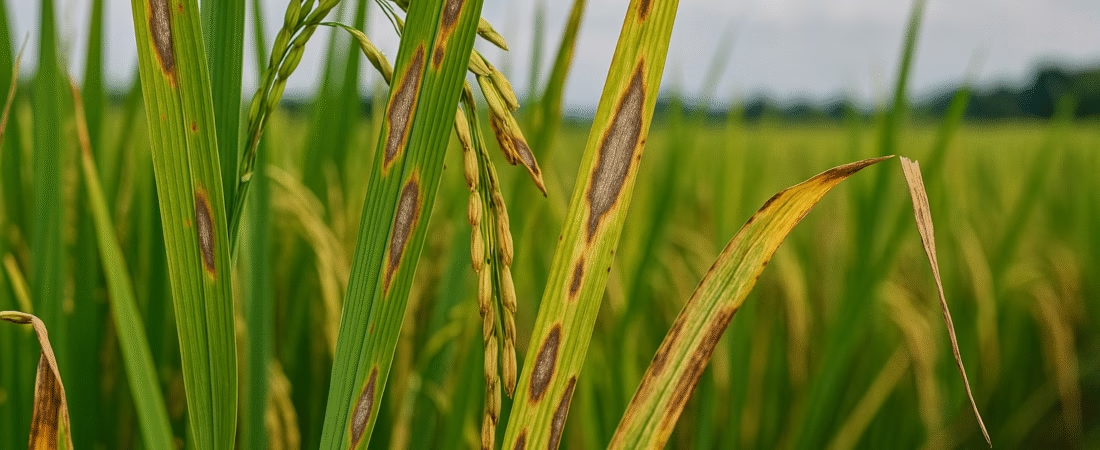
A. Leaf Blast:
- Appears early, from seedling to tillering
- Lesions: Diamond or spindle-shaped, gray center, brown/red border
- Multiple lesions lead to tip drying and chlorosis
B. Collar Blast:
- Appears at the junction of leaf blade and sheath
- Collar turns necrotic, leaf detaches
C. Node Blast:
- Blackening or browning of nodes
- Weak stem, plant may lodge (bend over)
D. Neck and Panicle Blast:
- Most dangerous stage
- Neck turns black and shrivels
- Panicle may not emerge fully or dries prematurely
- Grain filling is stopped = up to 100% yield loss
E. How to Differentiate from Other Diseases:
- Brown spot: Lesions are round, not spindle-shaped
- BLB (Bacterial Leaf Blight): Starts at leaf tips, no clear border, shows bacterial ooze
- Sheath blight: Oval lesions, usually on sheath, not leaf blade
Mnemonic: LNC(P) → Leaf, Neck, Collar (Panicle in severe cases)
5. Etiology — Fungal Biology
The life cycle of M. oryzae includes both sexual and asexual stages, but asexual reproduction is dominant in the field.
A. Mycelium:
- Septate, hyaline to olive, spreads in tissue
B. Conidia (Asexual Spores):
- Pyriform (pear-shaped), 3-celled
- Produced on conidiophores
- Spread via wind, germinate in 6 hours on wet leaf
C. Appressorium:
- Dark, dome-shaped infection tool
- Uses melanin to build high pressure (up to 8 MPa)
- Pierces leaf surface to start infection
D. Sexual Stage:
- Rare in nature, seen only under lab conditions
- Involves perithecia and ascospores
E. Special Biochemical Traits:
- Produces enzymes (cellulase, cutinase)
- Produces toxins (pyriculol)
- Has accessory chromosomes carrying effector genes
6. Predisposition — Why Blast Happens
Blast doesn’t appear out of nowhere. It thrives when three things align:
pathogen present, plant vulnerable, environment favorable.
A. Environmental Conditions:
- Humidity > 90%
- Leaf wetness for 12+ hours (due to dew, fog, rain)
- Temperature 25–30°C (day and night)
- Cloudy skies = less drying = longer wet leaf time
- Wind = spore dispersal across fields
B. Agronomic Factors:
- Excess nitrogen, especially urea at panicle stage
- Dense planting = poor airflow = humid microclimate
- Late planting = flowering during cooler humid season
- Monocropping = disease inoculum builds year after year
C. Host Susceptibility:
- Some varieties (e.g. TN1, Pusa Basmati 1) are highly susceptible
- Young tissues, especially new leaves and neck, are most vulnerable
D. Field History:
- If blast occurred last season, and residues remain, chances increase
- Infected straw and weeds can harbor spores
E. Mnemonic:
“HUMID 5”
- H: High Humidity
- U: Urea excess
- M: Monoculture
- I: Immature tissue
- D: Dew + 5: Ideal temp = 25–30°C
7. Management — Integrated Disease Strategy
No single solution works. We need IDM = Integrated Disease Management:
A. Cultural Practices:
- Use certified, disease-free seed
- Balanced fertilizers, avoid late nitrogen
- Spacing: 20×20 cm for airflow
- Keep field moist but not dry during flowering
- Burn residues, rotate crops with legumes
B. Biological Control:
- Trichoderma viride: 4g/kg seed, 2.5kg with FYM in field
- Pseudomonas fluorescens: 10g/kg seed, 0.2% foliar spray
- These act like “plant vaccines”
C. Chemical Control:
- Seed treatment: Tricyclazole @ 1g/kg or Carbendazim @ 2g/kg
- Foliar sprays:
- Tricyclazole 0.6g/l (best for neck blast)
- Isoprothiolane, Azoxystrobin, Carbendazim (in combination)
- Spray schedule:
- First: 45–50 days after transplanting
- Second: At booting stage
D. Resistant Varieties:
- India: CR Dhan 801, Tetep, Sahbhagi Dhan
- IRRI: IR64, IR36, IRBL series
- Carry Pi genes (e.g. Pi-ta, Pi-54, Pi-9)
8. Scientific Facts, Myths, and Tips
Beyond its direct impact on crops, Rice Blast is a fascinating case study in biology, evolution, culture, and human experience. This section uncovers hidden insights that blend science with field wisdom and folk tradition.
A. Scientific Insights — The Genius of a Fungus
1. Incredible Pressure Generation
The fungus forms a dome-like structure called the appressorium, which builds pressure up to 8 MPa — over ten times the pressure in a car tire. This allows it to physically puncture the rice leaf and initiate infection.
2. Rapid Genome Evolution
Magnaporthe oryzae has a relatively small genome (~40 Mb), but it mutates and adapts fast due to:
- Mini (accessory) chromosomes that can carry new virulence genes
- Frequent recombination events
- Selection pressure from resistant varieties
3. Effector Proteins & Immunity Hijack
The fungus secretes “effectors” — tiny molecules that shut down the rice plant’s immune system. These effectors evolve fast and are often stored on unstable chromosomes, making resistance short-lived.
4. A Threat Beyond Rice
This isn’t a one-crop pathogen. It has strains infecting millets, barley, wild grasses, and even a wheat-specific lineage — the notorious Wheat Blast, now threatening crops in South America and Asia.
B. Myths & Beliefs — Rice Blast in Culture and Folklore
Rice Blast has inspired fear and ritual in farming cultures for centuries.
Japan – Mochi-byo
In Edo-period Japan, Rice Blast was seen as punishment from angry field spirits. Known as mochi-byo (“rice cake disease”) because of the powdery lesions, farmers offered rice, sake, or incense at small shrines before harvest.
India – Cursed Panicles
In parts of Bengal and Odisha, panicles with blackened necks were believed to be cursed. Farmers would discard seed from such crops, associating the disease with spiritual imbalance or community sins.
China – Fire in the Field
Some Taoist farming texts describe “fields burning without fire” — likely early blast epidemics. These were blamed on cosmic disharmony or angry ancestors.
C. Practical Tips – From the Fields
Tip 1: Act Before Symptoms
If the weather forecast shows high humidity and your crop is at booting stage, apply Tricyclazole early. Prevention is far more effective than curing neck blast.
Tip 2: Don’t Use Late Urea
Top-dressing urea during flowering makes tissues soft and juicy — perfect for fungal entry. Use nitrogen wisely and early.
Tip 3: Grow Windbreaks or Diversify
Border rows of sorghum or cowpea help reduce wind-blown conidia. Diversifying crops also breaks the pathogen cycle.
Tip 4: Treat Your Seed — Always
Even visually healthy seed from a diseased field can carry spores. Always do seed treatment with Tricyclazole or Carbendazim.
D. Mnemonics – Easy to Remember
Here are some memory tricks for exams, fieldwork, and training sessions:
LNC(P) – Symptoms Breakdown
- L: Leaf blast
- N: Neck blast
- C: Collar blast
- (P): Panicle blast (subset of neck blast)
HUMID 5 – Conditions for Epidemic
- H: High Humidity
- U: Urea overdose
- M: Monoculture / Dense canopy
- I: Immature tissue (new leaves, neck)
- D: Dew or wetness >12 hours
- 5: Ideal temperature: 25–30°C
“45 + Booting” – Ideal Fungicide Spray Timing
- First spray: 45 days after transplanting
- Second spray: At booting (panicle initiation) stage
Epilogue : From Field to Future
As we close this journey from myth to microbe, the story of rice blast reminds us that the smallest organisms can shape the fate of millions.
In every field lesion, in every drying panicle, lies a dialogue—between environment and evolution, human effort and fungal adaptation.
Understanding rice blast isn’t just about controlling a disease. It’s about seeing the world in a grain of rice—and the battle it fights, silently, every season.
May this knowledge help us grow wiser fields, stronger crops, and a more connected agricultural future.
🔗 Verified References & Further Reading
All facts, figures, and terminology in this post are cross-verified from multiple trusted sources in plant pathology and rice research. Below are the main references:
- IRRI Rice Knowledge Bank – Rice Blast Overview and Management
https://www.knowledgebank.irri.org - TNAU Agritech Portal – Rice Blast (Leaf, Neck, Node Stages)
https://agritech.tnau.ac.in - ICAR-NRRI (National Rice Research Institute, India) – Fungal disease diagnostics & varietal data
https://icar-nrri.in - CABI Invasive Species Compendium – Magnaporthe oryzae disease profile
https://www.cabi.org/isc/datasheet/33984 - APSnet – American Phytopathological Society – Plant Disease Compendium
https://www.apsnet.org - Frontiers in Plant Science – Magnaporthe oryzae biology & pathogenesis article
https://www.frontiersin.org/articles/10.3389/fpls.2018.00656/full - Annual Review of Phytopathology – Epidemiology of Rice Blast https://www.annualreviews.org/doi/10.1146/annurev.phyto.43.012804.091939
- NCBI Genome & Taxonomy Portal – Magnaporthe oryzae Data
https://www.ncbi.nlm.nih.gov/Taxonomy/Browser/wwwtax.cgi?id=318829 - Plantwise Knowledge Bank (CABI) – India-specific rice blast factsheet
https://www.plantwise.org - ICAR e-Krishi Shiksha (Plant Pathology eBook)
https://ecourses.icar.gov.in - Agrios, G.N. – Plant Pathology (5th Edition) – For lifecycle, host-pathogen interaction, and melanin role in appressoria (Used offline)
- Alexopoulos, C.J. – Introductory Mycology – Fungal morphology and lab diagnostics (Used offline)
Leave a Reply
You must be logged in to post a comment.