
With the development of technology in the world it is now possible to manipulate matter on molecular levels. This new technology is called nanotechnology
What is nanotechnology
Nanotechnology is a technology which uses very small molecules to achieve an objective. The material used in nanotechnology is called nano-material. the dimensions of these materials are in the range of 1 to 100 nanometers which is equivalent to a tennis ball in comparison to our earth
Definition: “Nanotechnology is a process that builds, controls, and restructures materials that are the size of atoms and molecules.”
Who developed nanotechnology
While Nanotechnology is often viewed as a modern science, similar techniques can actually be traced back to ancient history (seen in artifacts like the Roman Lycurgus Cup).
However, in the modern era, the foundation was laid by two key figures:
- The Concept: Proposed by physicist Richard Feynman in his famous 1959 lecture, ‘There’s Plenty of Room at the Bottom.’
- The Term: The word ‘Nanotechnology’ was officially coined by Norio Taniguchi in 1974.
Why should we study nanotechnology
While nanotechnology is a new field with broad applications that attract pioneering minds, it can be arduous and difficult to grasp. Proper understanding requires deep knowledge of atoms, molecules, and the specific field where it is applied.
However, the effort is worth it. The use of nano-materials drastically increases the precision of our operations.
Think of it this way: If our current use of natural resources is like chopping wood, then nanotechnology is the act of carving sculptures out of it.
In essence, nanotechnology can be useful for
- increasing the depth of precision
- improving the efficiency of operations
- efficient use of raw materials
- achieve successful manipulation at nano scale
- improving the quality of products
How can we apply nanotechnology in agriculture
Nanotechnology is a rapidly evolving field. In a few decades, it will likely integrate into most branches of science, and agriculture is no exception.
Modern agriculture is input-intensive, meaning it relies heavily on chemical fertilizers and pesticides to maintain productivity. However, these traditional inputs are often inefficient.
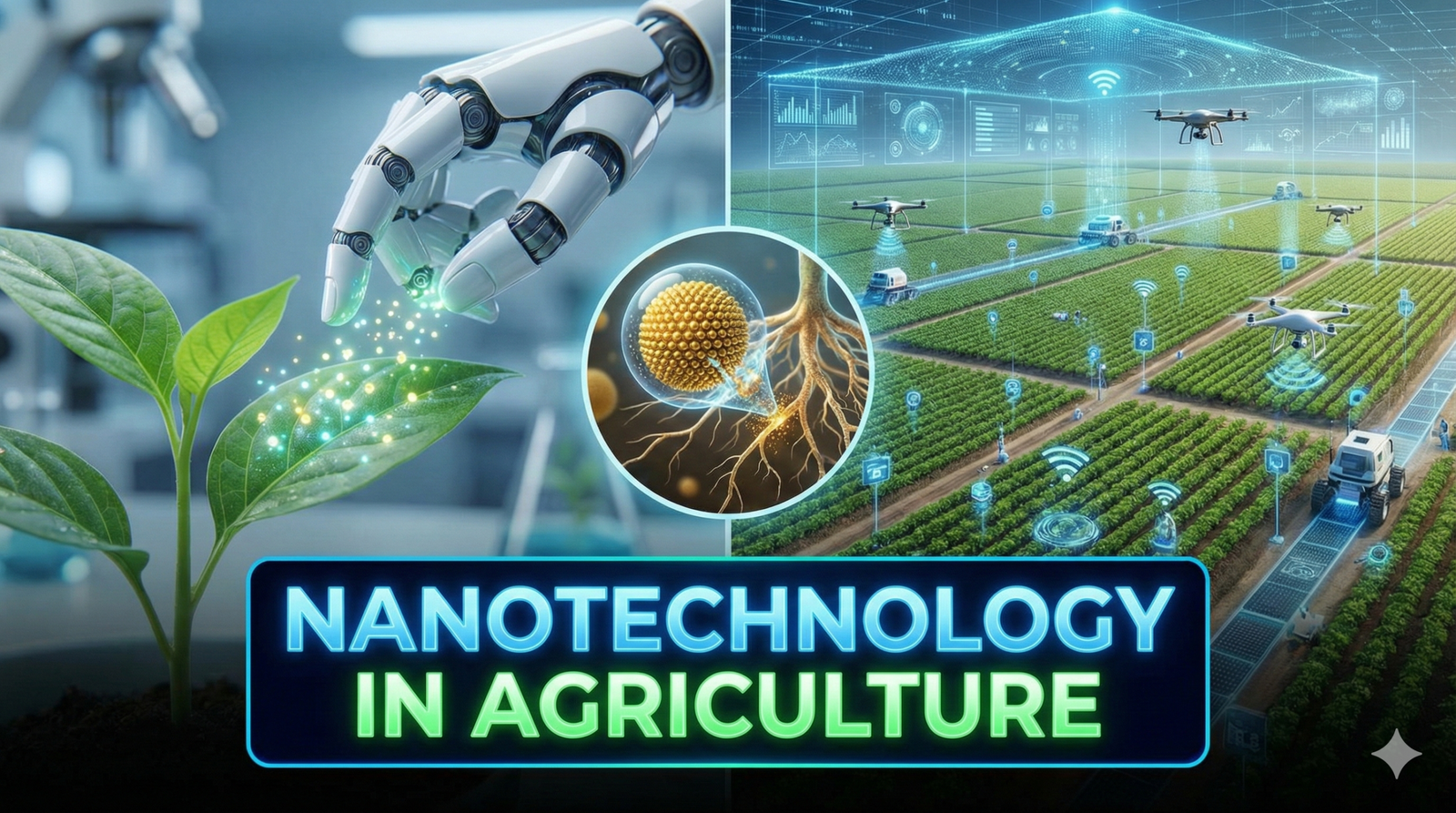
This is where Nanotechnology changes the game. By operating at the nano-scale, we drastically increase the total surface area of particles.
This increased surface area plays a crucial role in adsorption and absorption, making inputs far more effective. In agriculture, the focus is currently on three main areas: Nano-fertilizers, Nano-pesticides, and Nano-sensors.
1. Nano-Fertilizers (The Nutrient Solution)
Nutrients are critical for crop production; both deficiency and excess can cause yield losses.
The Problem: Conventional fertilizers are often lost through leaching (washing away) or fixation (becoming unavailable to the plant). Phosphoric fertilizers, for instance, often take too long to become available.
The Nano Solution: Nano-fertilizers solve this through two mechanisms:
- High Solubility: Their small size and high surface area allow for rapid absorption by roots.
- Targeted Release: Some nano-fertilizers are encapsulated to release nutrients slowly, ensuring the plant gets them exactly when needed, reducing waste.
2. Nano-Pesticides (The Safety Shield)
Insect pests are a serious challenge in every type of agriculture. Additionally, traditional pesticides are costly and detrimental to the environment. Nanotechnology offers a solution through nano-encapsulation, where pesticide molecules are inserted into cylindrical nanostructures (like Carbon Nanotubes).
These nano-capsules release toxins only when they enter the pest’s body. Furthermore, their microscopic size allows for an efficient, thin spread over the field, reducing costs and environmental residue.
The Risk: Although effective, the risk of biomagnification is alarming. Their small size allows them to pass through gut walls and accumulate in the body, potentially moving up the food chain.
3. Nano-Sensors (The Magical Eyes)
Nano-sensors represent a new era of technology where tiny devices gather real-time data from the field.
These sensors can detect diseases before symptoms appear or track nutrient levels in the soil instantly. This allows farmers to manage inputs precisely, preventing losses and saving money.

Leave a Reply
You must be logged in to post a comment.